Question
Do ultrasonic mouse repellers work?
By the MintGuard team · Updated 26 October 2026 · Who we are
Quick answer
Do not rely on an ultrasonic mouse repeller to clear an infestation. University extension guidance finds commercial sonic devices unreliable for pest control. Sound reaching a mouse does not ensure it will leave. Proofing, secure food storage and appropriate control matter more than a plug-in light or a whole-house coverage claim.
Signs to look for
- Compare fresh activity in the same places rather than judging a device by its light, a faint sound or a single quiet night. Keep a brief dated record.
- New gnawing, recurring droppings or damaged food packaging after installation are reasons to review the plan, not to assume the sound needs more time.
Do electronic mouse repellers work in a real home?
A glowing plug-in box shows that it has power, not that it is controlling mice. A quiet evening after installation is also not enough to establish success. Activity can vary between rooms or nights, and other changes such as removing food can explain an improvement.
The University of Arizona Extension review Sonic Pest Repellents, by Nicholas Aflitto and Tom DeGomez, revised in 2015, describes commercial sonic devices as ineffective. It also distinguishes experimental approaches from products sold to householders. That is not a test of every model on sale today, but it is a good reason to demand credible model-specific evidence rather than rely on testimonials.
Ultrasonic, sonic and electromagnetic: not the same claim
Ultrasonic means sound above the normal human hearing range. Sonic is a broader description and can include audible sound. Electromagnetic products claim to act through electrical systems rather than simply broadcasting airborne ultrasound. Some devices combine several functions. These labels should not be treated as interchangeable explanations.
Ask what the exact model emits, what independent evidence supports that mechanism and whether the test resembles an occupied home. A claim about one technology does not validate another feature in the same plastic casing. Nor does a frequency specification demonstrate that mice will leave a food source or nest.
Can ultrasonic mouse repellers work through walls?
Do not assume useful whole-house coverage from one socket. Walls, furniture and fitted units affect where airborne sound reaches. Kitchen cupboards and spaces behind appliances are not the same as an empty open test area. A large coverage figure on a box is not evidence of control in every concealed route.
Moving the unit into the middle of a room may change exposure without solving the underlying problem. Buying another unit for every room can become an expensive experiment. First inspect where fresh signs occur and whether mice are using service gaps, shared voids or stored food.
If you already own an ultrasonic unit
- 1Read the model instructions and pet exclusions before further use. Do not use it around pet rodents or other sensitive animals without appropriate advice.
- 2Keep electrical equipment away from water and do not hide a powered unit behind fabric or obstruct ventilation. Follow its electrical and location requirements.
- 3Treat any claimed coverage as something to question, not a map of protection. Inspect food and entry routes regardless of where the unit is plugged in.
- 4Set a prompt review based on fresh signs. Continuing activity needs inspection or control, not an open-ended trial while mice remain in the home.
Do mice get used to ultrasonic repellers?
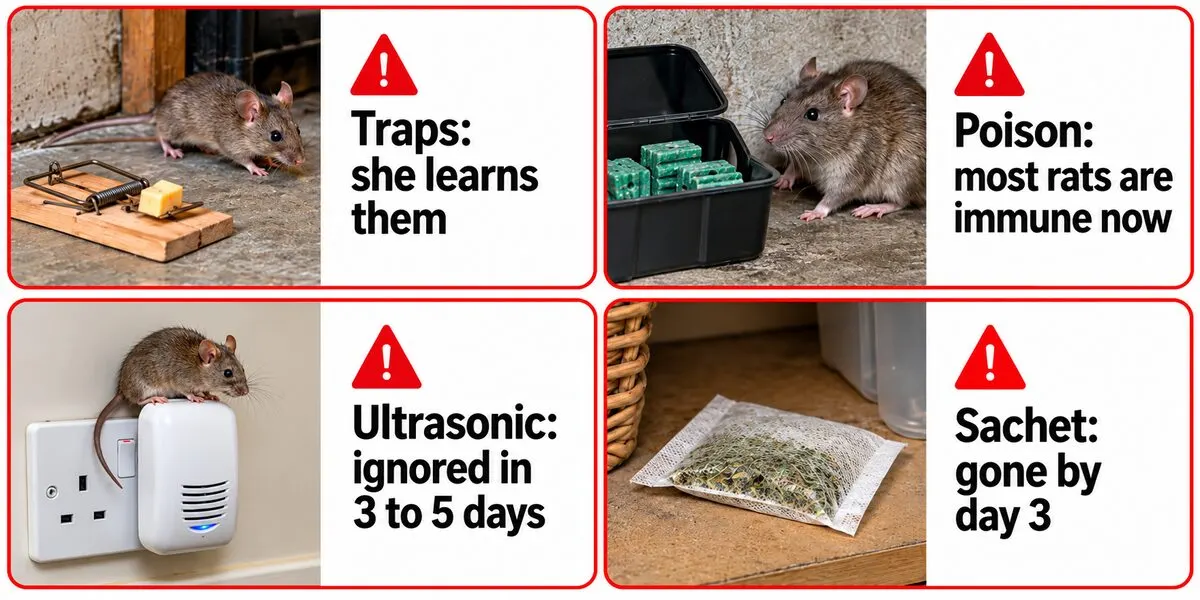
Habituation means an animal becomes less responsive to a repeated stimulus that does not carry a meaningful consequence. The Arizona review discusses the limitations of using sound for pest management. A reaction to a new sound should not be confused with sustained population control.
Changing frequencies or adding flashing lights does not by itself establish durable effectiveness. If a seller says its device prevents habituation, ask for evidence on that model and on continued household rodent activity. We would not advise waiting through continuing droppings simply because instructions promise an adjustment period.
What to do if your plug-in mouse repeller has not worked
You have not failed by trying an apparently simple option. Stop adding devices and write down where the newest evidence appears. Secure food and pet feed, check accessible gaps and contact a pest controller if activity is repeated or concealed. Keep pets and children away from affected areas.
Do not introduce an improvised trap or poison because a plug-in disappoints you. GOV.UK advises professional guidance when you are unsure how to use control methods correctly and explains the need to protect non-target animals. A live-capture trap also creates monitoring and welfare responsibilities; it is not automatically a simple humane answer.
Ultrasonic versus scent: our commercial interest
We are the MintGuard team and make the scent product featured here. That makes it especially important not to replace one unsupported promise with another. Evidence for scent deterrents is mixed too. A different delivery method is not proof of better infestation control.
MintGuard contains peppermint oil, clove oil and castor oil in 12 solid slow-release balls per pack. Each ball lasts 30 to 60 days, with no poison, traps or plug required. It can be considered as an optional scent measure where labelled placement is possible, alongside proofing, not as a guaranteed alternative to professional control.
Proofing checklist
- Repair suitable entry defects around doors and service openings. Use appropriate materials without covering vents or interfering with appliance safety.
- Store food securely and clear accessible crumbs, including pet-feed spills. Coordinate inspection with neighbours or a landlord if activity suggests shared routes.
| Approach | Cost basis | What to expect |
|---|---|---|
| Ultrasonic plug-in | Model price, electricity and possible extra units | No dependable infestation clearance; coverage claims need scrutiny |
| MintGuard scent balls | £39 one pack; £69 two; £89 three; £109 four | 12 balls per pack, 30 to 60 days each; mixed scent evidence |
| Proofing and food storage | Materials or a repair quote | Addresses entry and resources; maintain after installation |
| Professional control | Local quote with inspection and follow-up details | Preferable for persistent activity or hidden access |
Mistakes to avoid
- Do not compare an entire category using star ratings or anecdotes alone. Ask whether any claimed independent test measured sustained control in realistic conditions.
- Do not assume that because you cannot hear a device your pets cannot hear it or that it is harmless to every species.
When to call a professional
- Get professional help if mice remain active, the route is inaccessible, wiring is damaged or the problem affects more than one property. Ask for investigation and a prevention plan as well as treatment.
- Do not wait for a gadget trial if there is a food-safety concern or vulnerable occupants need the area made safe. Contact your landlord where relevant and retain dated evidence.
Prefer not to add another plug-in?
Start with entry repairs and a clear control plan. If an optional scent product suits your home, MintGuard needs no socket. The official shop offers tracked UK delivery, secure Shopify checkout and a 90-day money-back guarantee. No repellent purchase should delay needed professional help.
From £27.25 a pack · 90-day money-back · Tracked UK delivery
Try it risk-free for 90 days
If MintGuard doesn't help, the official shop refunds you. You get tracked UK delivery and secure Shopify checkout. How to check you're buying the real thing.
Common questions
Do plug-in mouse repellents really work?
Do not depend on them for clearance. Commercial sonic devices have a poor evidence basis for reliable pest control. Food storage, proofing and appropriate control remain necessary even if a unit appears to produce a short-term change.
Do ultrasonic repellers work through walls?
Do not expect airborne ultrasound to provide dependable protection through walls or enclosed cupboards. Obstacles affect exposure, and a claimed floor area does not prove that mice in hidden voids will leave.
How long do ultrasonic mouse repellers take to work?
There is no reliable universal clearance timetable. A promised waiting period should not justify ignoring fresh activity. Inspect the cause and arrange help if evidence continues.
Do electromagnetic mouse repellers work?
An electromagnetic claim needs its own evidence. It is a different proposed mechanism from airborne ultrasound. Do not accept a claim about one feature as proof that another clears household mice.
Can mice get used to ultrasonic repellers?
Animals can become less responsive to repeated stimuli. A device causing an initial reaction does not establish sustained control. Ask for evidence that a particular model prevents continuing infestation rather than simply producing sound.
Are scent repellents better than electronic mouse repellers?
We cannot support a blanket superiority claim. Scent evidence is mixed, and both approaches leave access and food unresolved. We make MintGuard, but still recommend practical repairs and professional control where appropriate.