Quick answer
There is no smell guaranteed to keep mice away. Peppermint and clove are common repellent ingredients, but evidence for scent deterrents is mixed. Mice may continue visiting for food and shelter despite an odour. Start with food storage and entry repairs; keep any optional labelled scent product fresh and safely out of reach.
Signs to look for
- New droppings, gnawed packets or repeated noises behind units warrant an inspection. Do not assume a small amount of evidence means there is only one mouse.
- Fresh crumbs scattered from damaged packaging can indicate ongoing feeding. Keep a dated note of the location to help distinguish new activity from old evidence.
What smell keeps mice away permanently?
No household fragrance should be described as a permanent mouse barrier. A mouse finding crumbs beneath a cooker or a route behind a cupboard still has a reason to visit. A scented pad near the kitchen door does not remove either opportunity.
Separate prevention from dealing with animals already inside. Prevention means reducing food access and repairing suitable entry points. Existing activity needs assessment and, where appropriate, a safe control plan. A deterrent is not a way of checking that a nest has gone or that every mouse has left a wall void.
Do mice hate peppermint and clove?
Peppermint and clove are familiar scent-repellent ingredients, but we cannot honestly rank their performance in UK homes or promise that either will make mice leave. Evidence is mixed. If you want to try a labelled scent product, use it as an optional addition to practical work, not the main treatment.
Human smell is a poor success measure. A room can smell very minty while food remains accessible behind the plinth. Conversely, a quiet night does not establish that a product worked. Keep a simple record of fresh signs in the same places so that decisions are based on continuing activity.
What smell do mice hate in a kitchen?
In a kitchen, food safety comes before fragrance. Keep repellent away from worktops, utensils, food packaging and accessible cupboards. Do not spray neat oils into drawers or place soaked pads beside cereal. Inspect stored food and keep affected items away from children and pets.
Look carefully at accessible pipe openings beneath the sink, damaged door edges and gaps around fitted units. Do not pull out heavy appliances, interfere with gas connections or cover ventilation grilles to place a product. A tradesperson or pest controller can examine routes that are awkward or unsafe to reach.
A mouse-scent plan for an occupied home
- 1Begin with accessible inspection and food storage. Keep children and pets away from suspected contamination and do not handle droppings to identify the animal.
- 2Check whether the chosen product can be placed as labelled without contact with food, animals or little hands. If safe placement is not realistic, do not use it.
- 3Keep a placement and inspection record. Maintain the product as directed while arranging repairs and reviewing any new signs. Stop treating scent as the answer if activity continues.
Vinegar, tumble dryer sheets and eucalyptus oil
Common online suggestions are not interchangeable or established solutions. Dryer sheets are designed for laundry, not food cupboards. Vinegar does not close access. Other essential oils, including eucalyptus, bring their own exposure concerns; switching fragrance is not automatically a safer choice.
PDSA lists peppermint, clove and eucalyptus among oils toxic to cats. Its guidance explains that cats may swallow oil after contact with fur and that some inhalation circumstances carry greater concern. Avoid applying oils to floors, bedding or surfaces a cat rubs against. Ask a vet about any formulation you intend to use around pets.
Keeping mice away from pet food and children’s spaces
Store dry pet food in sound closed containers and clear spills around feeding areas. Do not leave attractive snacks in open bags in a utility room. Where an animal needs food continuously, ask a vet or pest controller how to improve storage and housekeeping without compromising its care.
A child’s room or a pet enclosure is not a sensible trial site for exposed scent materials. Small solid items can be moved or mouthed. If you cannot maintain inaccessible placement, choose repairs and professional advice instead of trying to supervise a loose repellent all day.
Slow-release mouse repellent: what we make clear
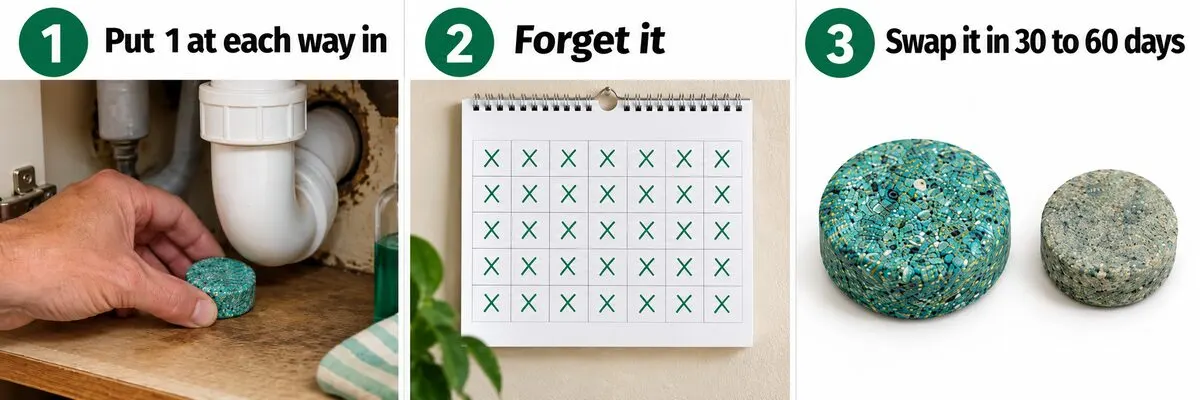
This site is written by the MintGuard team, and we make MintGuard. Each pack has 12 solid balls containing peppermint oil, clove oil and castor oil. Each ball lasts 30 to 60 days. There is no poison, no trap and nothing to plug in.
Those facts describe the product, not independent proof that it removes mice. A solid format avoids measuring loose oil but does not make chewing or swallowing acceptable. Follow the label, check placement regularly and do not keep adding product when the evidence points to an unresolved entry route.
Proofing checklist
- Inspect accessible service gaps and door defects, including utility-room routes. Select suitable durable repairs while preserving required ventilation and access for maintenance.
- For a suspected route within fitted furniture or a shared building, arrange a coordinated inspection rather than sealing visible gaps at random.
| Option | Cost consideration | Practical limitation |
|---|---|---|
| Loose essential oil | Bottle and repeated handling | Spills, pet exposure and no proven domestic dose |
| MintGuard | £39 for 12 balls; four packs £109 | Optional scent only; each ball lasts 30 to 60 days |
| Food containers and repairs | Depends on storage and defect | Addresses food access and entry rather than smell |
| Professional assessment | Request a local written quote | Useful for continued signs or concealed routes |
Mistakes to avoid
- Do not substitute strong perfume, cleaner or loose oil for an access inspection. Different household products are not approved rodent treatments merely because they smell strong.
- Do not assume a repellent is safe for pets because it contains no poison. Keep all products inaccessible and seek veterinary advice about uncertain exposure.
When to call a professional
- Seek a pest controller for repeated kitchen signs, damaged wiring, an inaccessible nest or activity across adjoining homes. Ask about finding the source as well as treating the immediate area.
- If you are unsure about traps, poisons or the species involved, follow GOV.UK advice and get professional guidance. Protect pets and other wildlife from any control measures.
Looking for an optional scent measure after the kitchen checks?
Consider MintGuard only where you can follow the label and keep it inaccessible. Shop at mintguard.co.uk with tracked UK delivery, secure Shopify checkout and a 90-day money-back guarantee. If mice are still active, prioritise inspection rather than another pack.
From £27.25 a pack · 90-day money-back · Tracked UK delivery
Try it risk-free for 90 days
If MintGuard doesn't help, the official shop refunds you. You get tracked UK delivery and secure Shopify checkout. How to check you're buying the real thing.
Common questions
What smell do mice hate the most?
There is no verified winner for household use. Peppermint and clove are commonly marketed scents, but a strong odour is not reliable exclusion. Remove food access and fix routes rather than chasing the strongest smell.
Does peppermint oil stop mice coming into the house?
It cannot guarantee that. Treat a labelled scent product as optional support, keep it fresh and work on building access. Continuing fresh signs mean the problem needs further assessment.
Do mice hate vinegar?
Do not rely on vinegar to keep mice out. It does not prevent entry or feeding. Use time spent maintaining vinegar trails to inspect storage and arrange suitable repairs instead.
Do tumble dryer sheets repel mice?
We would not recommend laundry sheets as a mouse-control method, particularly near food. They are not a substitute for proofing or safe removal of mice already indoors.
Is clove oil safe around cats?
PDSA lists clove among oils toxic to cats. Keep oil off fur, bedding and accessible surfaces. Contact a vet if exposure is suspected and provide the product details.
What keeps mice away permanently?
There is no permanent product guarantee. Good storage, maintained proofing and monitoring provide a more useful long-term approach. Recheck repairs when building work or wear creates new gaps.